





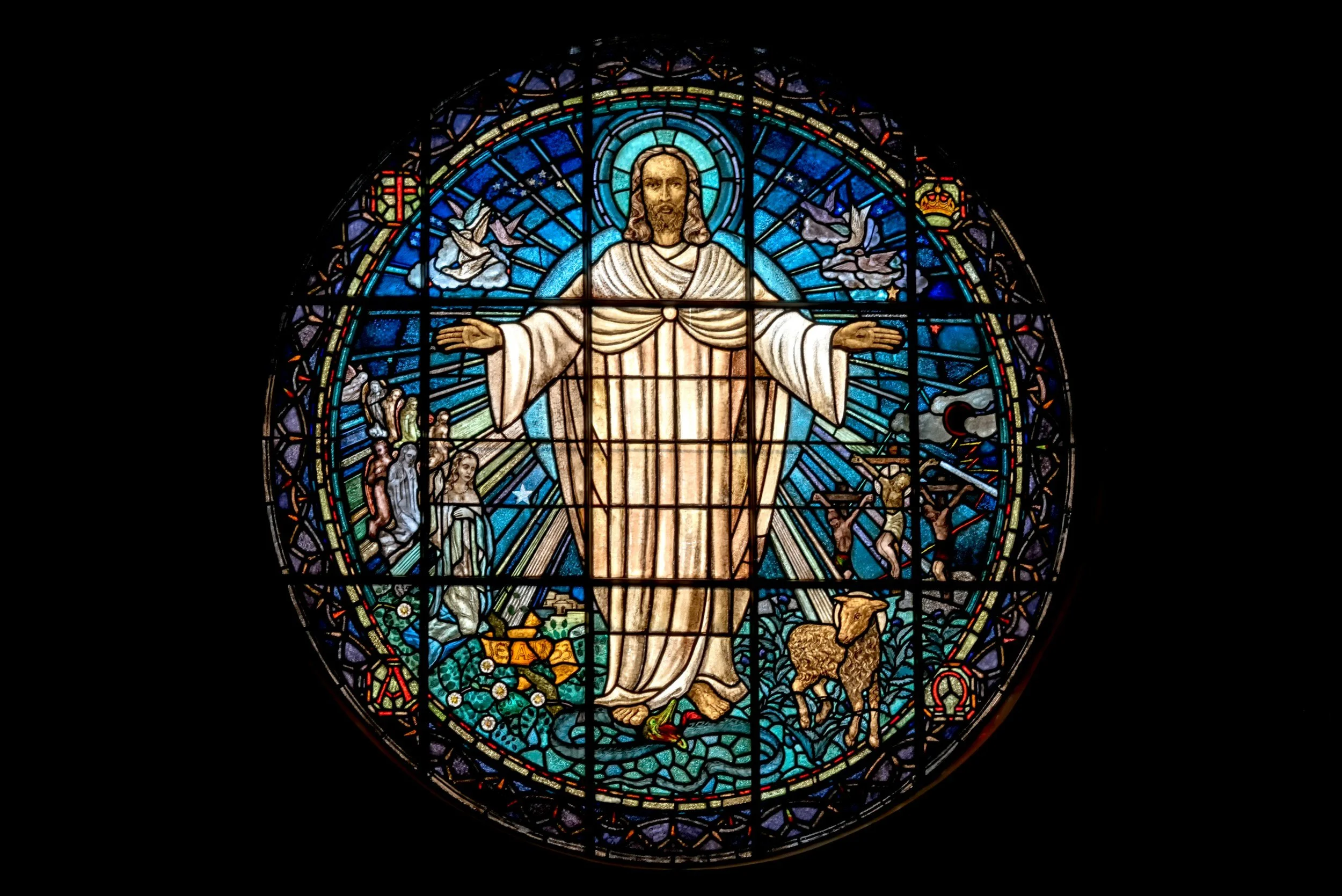
Easter Sunday Service (Traditional) | I Am the Resurrection and the Life | John 11:1-44

Easter Sunday Service (Traditional) | I Am the Resurrection and the Life | John 11:1-44

Throughout Lent we have looked at six of the seven “I Am” statements of Jesus. We’ve saved the best one for last here on Easter Sunday– “I Am the Resurrection and the Life.” We look at John 11 and the story of Jesus raising Lazarus from the dead. We see in this account three major differences in the way Jesus deals with death vs. how the world deals with death. How you deal with death says a lot about your belief system and what you think happens at death and after death. Death is terrible--do you try to minimize or ignore it, or do you treat it as the enemy, something worth crying about? Death is ugly–do you try to make it look prettier, or do you accept the ugliness and face it head on? Death is inevitable–do you try to control the timeline of your death, or do you meet it according to God’s timeline? In this sermon Pastor Smith shows how the world and Jesus both approach death in polar opposite ways. Which way will you approach, knowing that Jesus is the resurrection and the life?


The Glory of Burial | John 12:12-26

The Glory of Burial | John 12:12-26

Palm Sunday marks the beginning of Holy Week. Jesus rides into Jerusalem and is praised by the crowds. It seems to be a good start to the week…although we know what ends up happening. In this passage from John 12, we see some interesting things going on. Greeks are seeking Jesus. His enemies are making plans to kill him. And Jesus declares that it’s time for Him to be glorified. However, the type of glory Jesus is talking about is not what anyone else expects. It involves dying and being buried. On this Palm Sunday we will reflect on what kind of Jesus we expect to see, and which Jesus we end up seeing. What does burial have to do with glory? For Jesus, or for us for that matter?

Making Things Worse to Make Them Better | Matthew 26:47-68

Making Things Worse to Make Them Better | Matthew 26:47-68

This week we read about that sharp shift in the story of Holy Week in which now Jesus’ suffering and death becomes inevitable. He’s been predicting that it will happen, we’ve seen His enemies making their plans, and now finally things that have been long foretold are set into motion. It is interesting to see how Jesus responds as these things unfold. In the past He has used His divine power to ward off physical danger and verbal traps. But now on this Thursday evening…Jesus changes course. He doesn’t take any action to protect Himself. Rather, each thing He says or does actually hurts His cause and leads Him closer to certain death. What can we learn from this? How is the life of a Christ follower also marked by a commitment to make things worse personally in the short term in order to make them better in the long term? Pastor Smith explores this based on the words and deeds of Jesus in this passage from the passion narrative in Matthew’s Gospel.

One | John 17:6-26

One | John 17:6-26

In America today, a lot of people have the mentality that faith is just a matter of “me and Jesus.” In John 17, Jesus’ high priestly prayer, he prays for all Christians- that they would be one. Join Pastor Josh as he dives into what that actually looks like in our lives as followers of Jesus.

What a Waste | Mark 14:1-11

What a Waste | Mark 14:1-11

This week we focus on the wasteful woman who dumps a bunch of expensive ointment on Jesus' body. Some people who see this are deeply offended that she would waste such an amount of money in such a foolish way–it could have been sold and the proceeds given to the poor. On the surface, this seems like a logical reaction…but there is more going on here, isn’t there? We will explore how this “wasteful” act is actually one of the most powerful expressions of faith the world has ever seen. Are there other acts that might seem wasteful or wrong that followers of Jesus do? The world may declare, much like the onlookers in this story, that we are being wasteful. But when we act in faith, looking forward to Jesus’ words coming true, we are absolutely not being wasteful.

The Coldest Ticket in Town | Matthew 22:1-14

The Coldest Ticket in Town | Matthew 22:1-14

We have arrived at Holy Week in our Bible reading plan. In the early part of the week, Jesus has a “head to head” with his major opponents. They try to trip him up in His words, but as usual, they fail. Jesus tells several parables directed at them to pronounce judgment upon them for their sinful rejection of Him, and by extension their rejection of the Father. These are difficult parables for faithful Christians to read. The exact condemnations do not apply to us, but we would do well to receive these stories as sober warnings, lest we also become proud, entitled, and think lightly of God’s grace. The Parable of the Wedding Feast shows God’s generous invitation for all people to take part in the Son’s wedding feast…but it also shows God’s just judgment upon those who are dead set on dishonoring His Son. 

What if God Means What He Says? | Luke 16:19-31

What if God Means What He Says? | Luke 16:19-31

The parable of the Rich Man and Lazarus is almost like a scene out of a horror movie. It is striking and haunting. The rich man is suffering in hell, but he wants to send a message back to his living brothers to warn them. Father Abraham, up in heaven, essentially says “They have God’s Word. That’s all they need.” Today the reality is the same–people have God’s Word. That’s all they need. People will have no excuses on Judgment Day. So many people live as if God doesn’t really mean what He says. What if He does though? This sermon explores how people think about God’s Word today. Is it optional? Is it filled with suggestions? Or is it filled with eternal truths that have an eternal bearing on us?

The Lost and the Found | Luke 15:1-3, 11-32

The Lost and the Found | Luke 15:1-3, 11-32

The parable of the Prodigal Son is one of the most famous that Jesus tells. He narrates this parable in response to outrage that He would associate with sinful people. The reality is that God actively seeks out lost sinners and all of heaven rejoices when the lost repent and become the found children of God, redeemed by His grace. In this sermon, Pastor Smith looks at this parable from several different angles. What is God’s attitude toward the lost? How should the found feel about the lost? Which son, in the end, is actually the lost one? This parable is so famous and beloved because it reveals in dramatic detail the boundless mercy and grace God has toward lost sinners. It is good news for us all.

Will the Real Jesus Please Stand Up? | Matthew 16:13-28

Will the Real Jesus Please Stand Up? | Matthew 16:13-28

This sermon focuses on Jesus’ conversation with his disciples. He asks “Who do people say that I am?” Several answers are given, all of them kinda sorta close, but definitely wrong. The most dangerous false versions of Jesus are the ones that are kinda sorta close…but definitely wrong. We will explore some of these false Christs, and look for the real Jesus as revealed in the Scriptures. 

Put Your Heart Into It | Matthew 5:17-37

Put Your Heart Into It | Matthew 5:17-37

This week we take a look at Jesus’ Sermon on the Mount. Again and again Jesus reveals the original intent of God’s Law. Over the centuries, it’s been weakened repeatedly by sinful human beings looking for loopholes. Today we also love a good loophole, especially when it allows us to avoid a difficult aspect of God’s Law. This love for loopholes reveals a heart condition. We may go through the motions of obedience, but is our heart into the act of truly following God’s will? We will examine our own heart condition, as well as rejoice in the fact that God Himself has a heart condition that leads Him to fulfill the Law Himself and save us.

The Relatable Reversal | Luke 1:39-56

The Relatable Reversal | Luke 1:39-56

Some things that you experience in life are so strange and unrelatable to most people. Usually we try to seek other people out who have gone through similar life experiences. Mary and Elizabeth are both going through unique circumstances. Both have received outlandish news from an angel and both are now impossibly pregnant! This is unrelatable to the rest of humanity. Mary eventually sings a song of praise, known as the Magnificat. In this song, she describes how God reverses the world’s expectations in the way He brings salvation. What she sings about will be relatable to all people: the proud and arrogant and ungodly will fall from their seemingly secure positions, while the humble, lowly ones who trust in God will be raised up and graciously blessed. All people will be able to relate to these experiences.